Floating Solar: What It Is and Where It Makes Sense in Florida
Florida has a problem that most solar markets would envy: too much demand for clean energy and not enough available land to put it on. With population growth, land prices, conservation priorities, and agricultural needs all competing for the same acreage, developers and municipalities are increasingly looking for creative siting solutions. Floating solar – solar panels mounted on structures that float on the surface of a body of water – is emerging as one of the most practical answers to that challenge.
At 15 lightyears, we have been at the leading edge of floating solar deployment in Florida. This post breaks down what the technology is, why Florida is one of the most compelling markets for it in the country, and what it looks like in practice on a real project.
What Is Floating Solar?
Floating solar – sometimes called floatovoltaic or floating PV – is exactly what it sounds like: solar panels mounted on buoyant structures anchored to the floor or shoreline of a water body. The panels generate electricity the same way ground-mounted or rooftop arrays do, but the platform beneath them floats on a pond, reservoir, lake, retention basin, or other body of water.
The concept has been around longer than most people realize. The first documented floatovoltaic system was installed in 2009 on an irrigation pond at a Napa Valley winery in California. Since then, the technology has expanded rapidly – particularly in land-constrained markets across Asia – and is now gaining real traction in the United States, with Florida emerging as one of the most active deployment states.
Floating solar systems typically include:
- Monocrystalline or polycrystalline solar panels (the same panels used in conventional arrays)
- Floating platforms or pontoon structures made from durable, UV-resistant materials
- Mooring and anchoring systems to keep the array in place
- Cabling routed through or alongside the water body to a shore-based inverter
- Monitoring systems for remote performance tracking
Why Floating Solar Works Especially Well in Florida
Florida’s geography, climate, and development pressures combine to make it one of the most suitable environments for floating solar in the country.
Abundant sunshine and water. Florida leads the contiguous U.S. in both solar irradiance and the density of water bodies – lakes, ponds, reservoirs, stormwater retention basins, and canals are found on nearly every commercial and residential development. That combination is rare and valuable.
The cooling effect boosts efficiency. One of the most significant technical advantages of floating solar is panel temperature. Solar panels lose efficiency as they heat up – a well-documented phenomenon that reduces output during peak afternoon hours. Water acts as a natural coolant beneath the array. Research has shown that floating PV can achieve energy yield increases of up to 35.9% compared to conventional ground-mounted systems, with the cooling effect being a primary contributor. In Florida’s summer heat, this matters.
Water conservation as a co-benefit. Floating panels shade the water beneath them, which meaningfully reduces surface evaporation. In a state where freshwater management is a constant concern, this is a genuine environmental co-benefit – not just a talking point.
Reduced algae growth. Shading also limits the sunlight available for algae blooms, which are a persistent issue in Florida’s warm, nutrient-rich water bodies. Floating solar can improve water quality as a byproduct of energy generation.
Land pressure. Florida faces intense competition for land among housing, agriculture, conservation, transportation, and commercial development. Floating solar on existing water bodies sidesteps that competition entirely, turning already-managed surfaces into productive energy infrastructure without displacing anything else.
Where Floating Solar Makes Sense
Not every water body is suitable for floating solar, and site selection matters. The technology is best suited for:
Residential and mixed-use developments with retention ponds. Florida’s development code requires stormwater retention ponds on nearly every large residential or commercial project. These ponds are typically fenced, largely unused, and perfectly positioned to host floating solar arrays that serve the development’s common areas or clubhouse loads.
Municipalities and public utilities. Cities and counties with sustainability commitments are increasingly turning to floating solar on existing public water bodies – stormwater ponds, reservoir systems, and utility-managed basins – as a way to add renewable capacity without acquiring new land or disrupting existing use. Florida’s density of publicly managed water bodies makes this a particularly compelling option at the municipal level.
Universities and campuses. Nova Southeastern University recently completed a 700 kW floating solar array – the first at a university in the United States – on a campus water body, directly powering student housing. The project demonstrated that institutions with limited roof or ground space can still deploy meaningful solar capacity.
Industrial and commercial facilities. Mining operations, water treatment plants, agricultural irrigation ponds, and manufacturing facilities with on-site water bodies are all strong candidates. The technology works well in contexts where the water body is already managed and the energy load is consistent.
The Kelson Floating Solar Project: A 15 lightyears Case Study
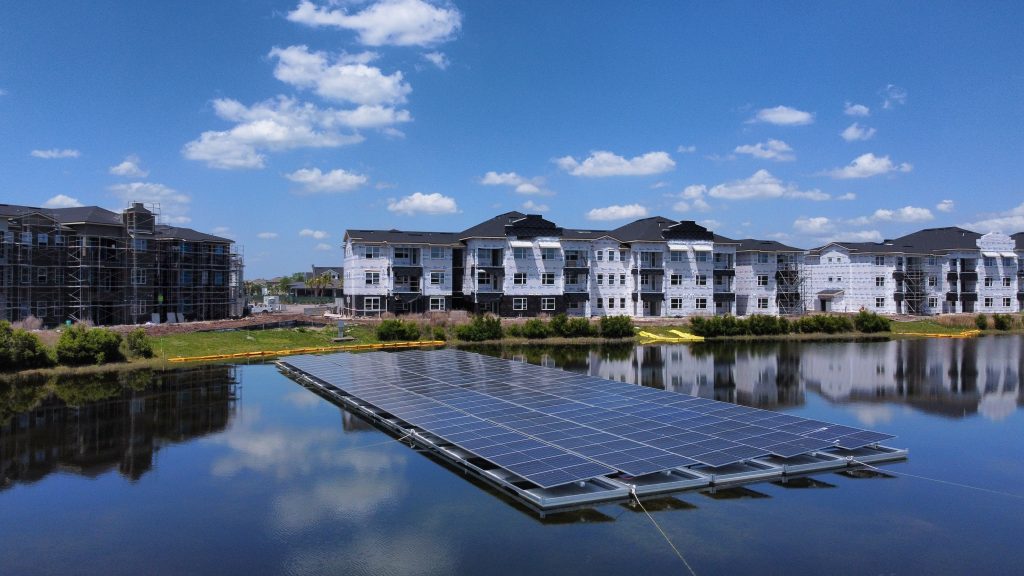
One of the best illustrations of where floating solar makes practical sense for developers is the Kelson Floating Solar Project in Lake Nona, Orlando – a project completed by 15 lightyears in partnership with AccuSolar, Florida’s leading floating solar manufacturer and installer.
The Kelson Apartments is an upscale, eco-conscious residential development in the Lake Nona area. The development’s design already reflected a commitment to sustainability – and the developer wanted the clubhouse, a central shared amenity, to reflect those values in a tangible way. The solution was a net-zero energy floating solar array designed specifically for the clubhouse’s energy load.
The array was installed on the development’s water feature, using the efficient cooling properties of the water to maximize panel performance in Florida’s intense summer heat. The system is designed to fully offset the clubhouse’s energy consumption – making it a net-zero facility powered by clean, on-site renewable energy.
This project is a strong model for what floating solar can look like in the context of upscale residential development:
- No land consumed. The array sits on a water feature that already existed as part of the landscape design.
- Net-zero performance. The clubhouse’s full energy load is offset by on-site generation.
- Amenity, not eyesore. Well-designed floating arrays can be an architectural feature that reinforces a development’s sustainability brand.
- Resident and buyer appeal. In an eco-conscious development like Kelson, the floating solar installation is a differentiator that reflects the values of the community it serves.
Projects like Kelson demonstrate that floating solar is not a niche infrastructure play – it is a practical, elegant solution for developers who want to deliver on sustainability commitments without compromising design or land use.
What to Consider Before Installing Floating Solar
Floating solar is an excellent fit for many projects, but it is not without considerations. Before moving forward, developers and building owners should evaluate:
Water body suitability. Depth, surface area, water chemistry, shoreline access, and any environmental designations all affect feasibility. Most retention ponds and man-made water bodies in Florida are well-suited; natural lakes and wetlands require more careful environmental review.
Anchoring and storm resilience. Florida’s hurricane exposure is real. Quality floating solar systems are engineered for wind and storm loads, but the anchoring system design is critical. Anchoring can be achieved in two primary ways depending on the site: underwater anchoring, where mooring lines connect directly to the pond or lake floor, and on-land anchoring, where cables run to fixed points on the shoreline or surrounding infrastructure. Both approaches are proven and effective – the right choice depends on the specific water body, depth, soil conditions, and storm exposure of the project. Working with experienced installers who understand Florida’s weather profile and can tailor the anchoring system to your site is essential.
Permitting. Floating solar on water bodies may involve permitting through water management districts, local governments, and in some cases the Army Corps of Engineers, depending on the classification of the water body.
Upfront costs. Floating solar typically runs 10-15% higher in upfront cost compared to equivalent ground-mounted systems, due to the additional structural components. However, that premium is often offset by avoided land costs, improved panel efficiency, and the water conservation co-benefits – particularly in Florida.
Available incentives. Florida’s sales tax exemption on solar equipment and property tax exemption for solar installations both apply to floating systems. The federal Investment Tax Credit (ITC) also applies, covering a significant portion of installation costs.
Branding opportunity. Floating solar arrays offer something ground-mounted and rooftop systems typically don’t: visible, customizable surface area. Panel frames and surrounding structures can incorporate developer or investor branding, turning the array into a marketing asset that reinforces the project’s sustainability identity and extends visibility to residents, guests, and passersby. For eco-conscious developments, this is a meaningful differentiator that communicates values at a glance.
Rising utility costs make the ROI case stronger. Florida electricity rates have climbed steadily, and for multifamily investors and commercial developers, utility costs directly affect tenant satisfaction and retention. Floating solar systems that offset common area or shared building loads reduce operating expenses – and those savings can be passed on to tenants or used to strengthen lease terms. In a competitive rental market, energy cost relief is increasingly a factor in how tenants choose and stay in a property. For investors, that translates directly into occupancy, NOI, and asset value.
Florida Is Leading the Way
Florida is quickly establishing itself as one of the most active floating solar markets in the United States – and for good reason. The combination of land pressure, solar resources, abundant water bodies, and a growing base of experienced installers and developers makes the state a natural proving ground for the technology.
From university campuses to municipal water bodies to upscale residential developments like Kelson, floating solar is moving from novelty to mainstream in Florida. The projects being built today are establishing the track record, refining the engineering, and building the case for wider adoption.
If your project includes a water body – a retention pond, a lake, a stormwater basin – it is worth asking whether that surface could be doing more than managing runoff. In many cases, the answer is yes.
Talk to 15 lightyears About Floating Solar
15 lightyears specializes in commercial solar solutions across Florida, including floating solar for developers, municipalities, and commercial building owners. We bring deep expertise in solar system design, installation, and performance verification – and our work on the Kelson project demonstrates what thoughtful floating solar design looks like in practice.
If you’re a developer, municipality, or commercial building owner with a water body on your property and a sustainability goal on your roadmap, reach out to our team to explore whether floating solar is the right fit.
Talk to an expert at 15 lightyears
15 lightyears is a Certified B Corporation headquartered in Longwood, Florida, specializing in commercial solar energy, energy performance testing, HERS ratings, green certifications, and corporate sustainability. Licensed Electrical Contractor: EC13005057.